I'be been using the FiiO/Snowsky Echo Mini for about a month now, so I decided to write down my experience with it so far.
The physical aspect
There are things I noticed within the first thirty minutes of using it. It's entirely made out of plastic. Although not cheap-feeling, it does feel light and not very premium.
It's way smaller than I anticipated, which is an upside for me. It's around the size of a cassette, slightly thicker and slightly less wide. The buttons don't feel bad but they are pretty loud, which can make it embarrassing when browsing through folders in public.
I haven't tried the balanced output yet, but the 3.5 output feels solid and I haven't experienced any contact issues. It has four hex screws on the backside, so I expect it not to be very hard to repair if ever needed.
The screen is surprisingly good for its size and price. The colors and contrast are good enough to display most album covers as well as having enough space to fit all the retro UI elements.
Both the USB-C port and the microSD slot have worked flawlessly so fo far, though I do wish that the latter was covered instead of exposing the card.
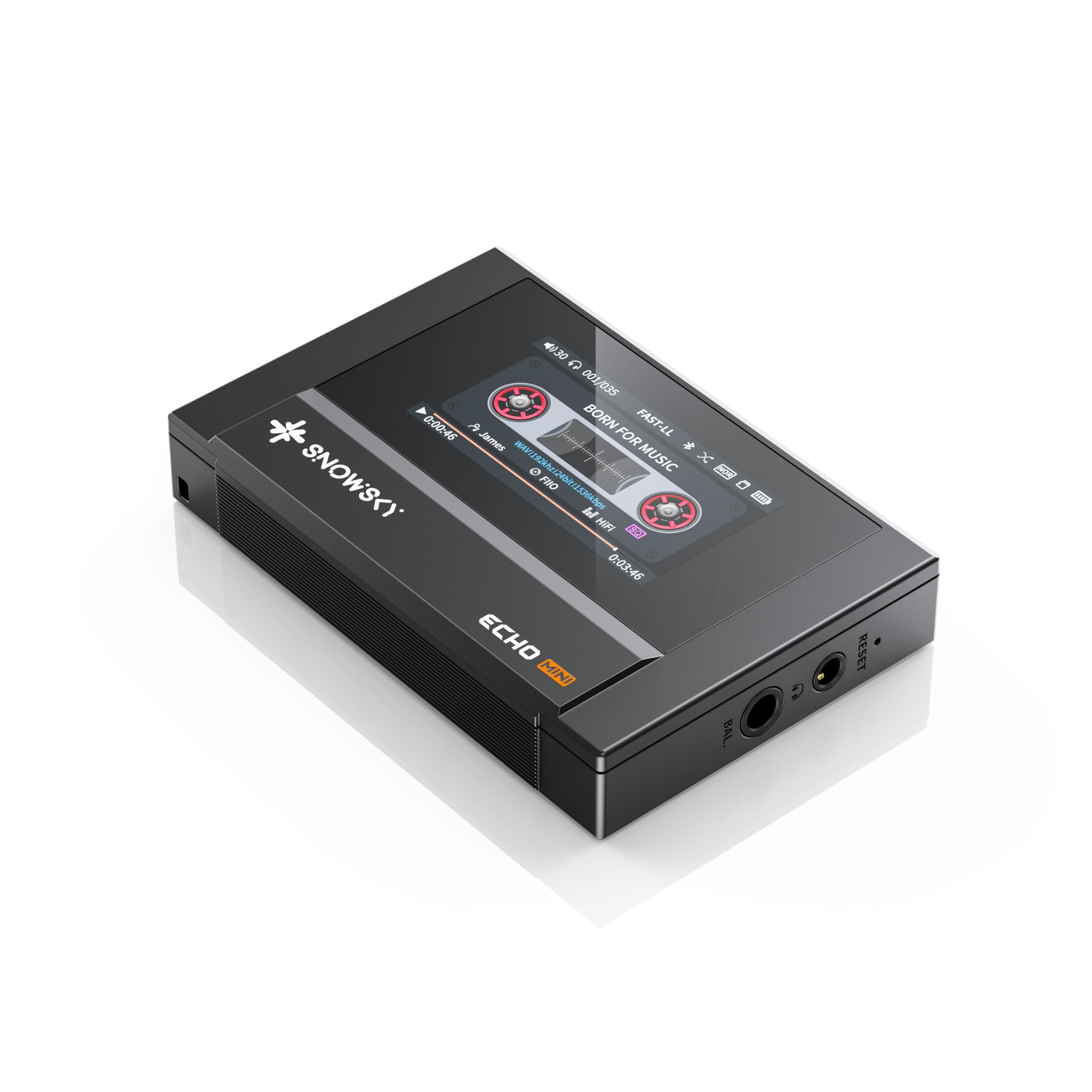
The Echo Mini
The firmware
FiiO's stock firmware is perfectly serviceable, although it does raise some complaints: The button's functions are not very intuitive, the library takes a while to load, as does the startup sequence, which is extremely long taking into account the frequency in which a device like a DAP is automatically shut off.
For those reasons I looked into RECHO, a custom firmware for the Echo Mini which aims to solve the stock firmware's issues.
RECHO is a pretty substantial upgrade from the default experience: greatly simplifying the menus, remapping the buttons, and giving it a pretty slick text-centered UI.
There are some things that are lacking from RECHO, most notably the absence of USB DAC mode (which is apparently in the works), artwork display (which hasn't been mentioned in the developer's webpage) and, most annoying of all: The SD card not being accessible through USB. The only filesystem that you can edit via USB is the built-in storage, which in my case is thankfully 8GB. The developer has specifically said that this is on purpose and there are no plans to make it a feature in the forseeable future. Bluetooth is also not supported, but that is a minor loss.
FiiO has announced that they will be making their firmware open-source, so I eagerly look forward to seeing better takes on this device's potential software.
The sound
This is unmistakeably a modern music player, and its sound makes sure that is clear. It has one of the most balanced DACs I have ever heard: Coming from the iPod's, which is famously warm, it has an almost sterile sound to it.
That's not to say it doesn't sound great, which it absolutely does.
The Amplifier is powerful enough. It has no trouble running my Cadenza II with plenty of headroom, but it does get a bit tighter when it gets to my Sennheiser HD 558 (A review for which will almost surely come). I have yet to test the balanced output, which is supposed to deliver twice the power, but that will have to wait until I buy its adapter.
Conclusion
Overall, the FiiO Echo Mini is a really good DAP for its price. Although the sacrifices that were made for it to exist do make themselves apparent at times, a good firmware alleviates them noticeably.
I am happy that I bought it, as it has delivered on almost all fronts I expected it to.